1 Micrometer to 1 MM: The Complete Conversion Guide for Precision Measurement in 2026
A practical, no-nonsense guide to converting between micrometres and millimetres — covering the maths, the tools, and why getting this right matters for engineering, manufacturing, and quality control work across the UK.
Understanding 1 Micrometer to 1 MM

One micrometre (µm) equals 0.001 millimetres. That's the core fact. Simple enough on paper, but I've seen experienced machinists trip up on this conversion when they're under pressure on the shop floor.
So why does the relationship between 1 micrometer to 1 mm matter so much? Because in precision engineering, a single micrometre can be the difference between a component that fits and one that gets binned. We're talking tolerances tighter than a human hair — which, for reference, sits around 70 µm thick.
Key fact: 1 mm = 1,000 micrometres (µm). Conversely, 1 µm = 0.001 mm.
I work with measurement tools daily, and honestly, once you've internalised this 1:1000 ratio, every conversion becomes second nature. The metric system is brilliant like that — clean powers of ten, no messing about with fractions of inches.
The micrometre (sometimes spelled micrometer — same thing, different context) is the SI unit sitting between the millimetre and the nanometre. In UK manufacturing, tolerances specified in micrometres are standard for anything from aerospace components to medical devices. The British Standards Institution (BSI) references micrometre-level tolerances across dozens of ISO standards governing precision parts.
Conversion Formulas: Micrometer to MM and MM to Micrometer
The maths here won't give anyone a headache. Two formulas cover everything you'll need.
Convert Micrometer to MM
Divide by 1,000. That's it.
Formula: Value in mm = Value in µm ÷ 1,000
Example: 500 µm ÷ 1,000 = 0.5 mm
Convert MM to Micrometer
Multiply by 1,000.
Formula: Value in µm = Value in mm × 1,000
Example: 0.05 mm × 1,000 = 50 µm
Dead simple. But here's where people get caught out — decimal places. I've checked drawings where someone wrote 0.01 mm when they meant 0.1 mm. That's a tenfold error. In a production run of 10,000 parts, that mistake costs thousands of pounds. So double-check your zeros.
Well, actually, the conversion itself isn't where most errors happen. It's transcription. Someone reads 25 µm off a micrometer gauge and writes 0.25 mm instead of 0.025 mm. I'd recommend always writing both units side by side on inspection reports.
Quick Mental Trick
Moving from µm to mm? Shift the decimal point three places left. Going from mm to µm? Three places right. Sorted.
Common Micrometer to MM Conversions: Reference Table
Here's a reference table I keep pinned above my workspace. Covers the conversions that come up most often in workshop and lab settings across the UK in 2026.
| Micrometres (µm) | Millimetres (mm) | Typical Application |
|---|---|---|
| 1 µm | 0.001 mm | Optical coating thickness |
| 10 µm | 0.01 mm | Surface finish (Ra values) |
| 25 µm | 0.025 mm | Precision bearing clearance |
| 50 µm | 0.05 mm | Standard machining tolerance |
| 100 µm | 0.1 mm | Sheet metal thickness gauge |
| 250 µm | 0.25 mm | Fine wire diameter |
| 500 µm | 0.5 mm | PCB trace width |
| 1,000 µm | 1.0 mm | General engineering tolerance |
| 0.05 mm (converted) | — | = 50 µm (micrometer thimble graduation) |
1000 micrometer to mm = 1 mm exactly. 100 micrometer to mm = 0.1 mm. 0.05 mm to micrometer = 50 µm., a favourite among Britain’s tradespeople
These aren't abstract numbers. When you're checking a bore diameter or verifying a surface finish reading, having these conversions memorised saves time. And time on the shop floor is money — especially when you're running CNC jobs at £85/hour machine rates.
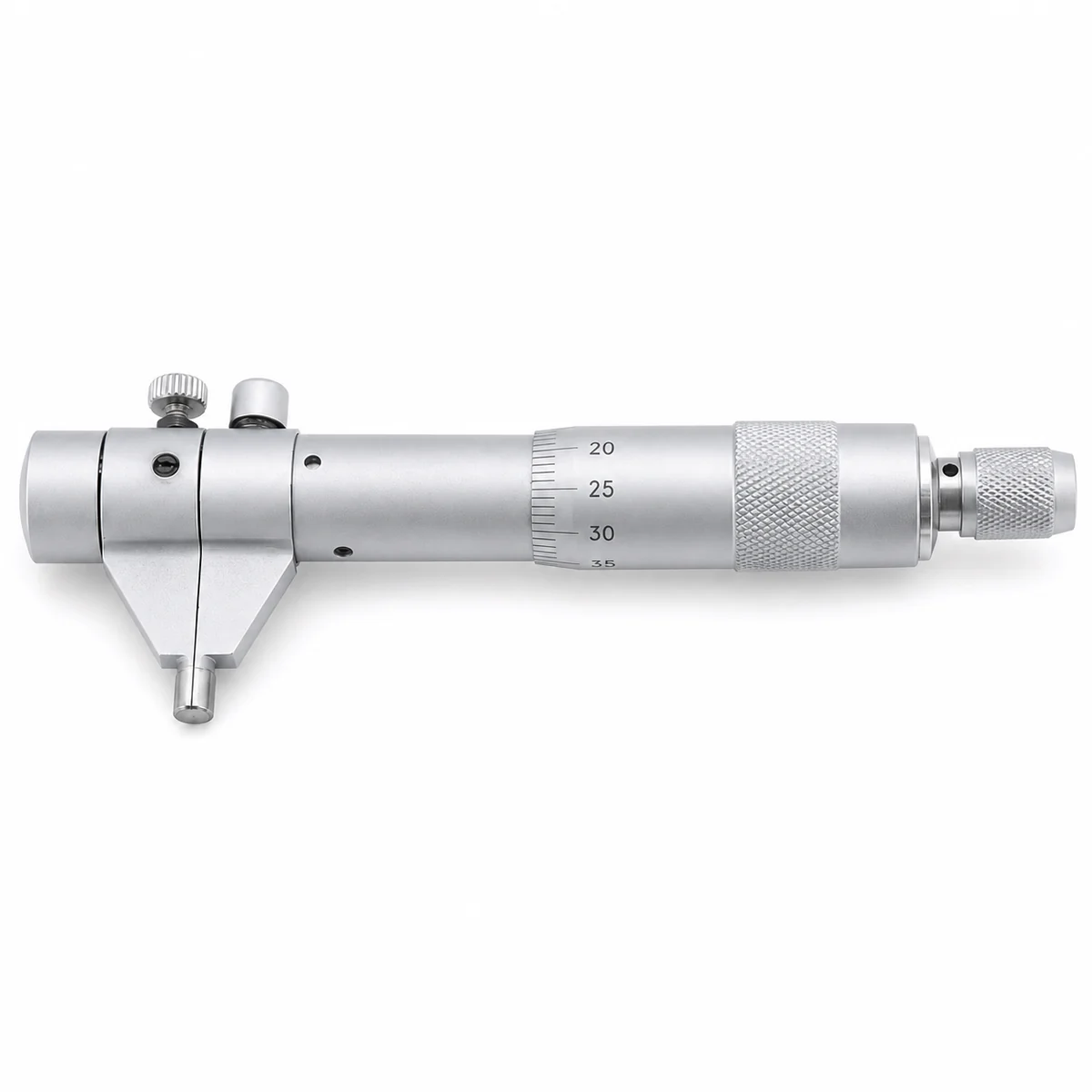
How to Use an Inside Micrometer Properly

An inside micrometer measures internal dimensions — bore diameters, slot widths, that sort of thing. It's a different beast from your standard outside micrometer, and it takes practice to get consistent readings.
Step-by-Step Method
1. Zero check first. Always verify your instrument reads zero (or the correct setting gauge value) before measuring. I've wasted twenty minutes chasing a phantom tolerance issue that turned out to be a dirty anvil face.
2. Insert and rock. Place the micrometer inside the bore, then gently rock it back and forth while rotating it slightly. You're looking for the minimum reading — that's your true diameter.
3. Read the scales. The sleeve shows whole millimetres and half-millimetres. The thimble divides each 0.5 mm into 50 graduations, giving you 0.01 mm resolution. Some instruments have a vernier scale on the sleeve for 0.001 mm (1 µm) readings.
4. Record in both units if needed. A reading of 25.347 mm equals 25,347 µm. The mm to micrometer conversion here is just moving that decimal.
Common Mistakes
Applying too much pressure is the big one. The ratchet stop exists for a reason — use it. Overtightening gives you a false reading and can damage the measuring faces. My mate who runs a machine shop in East Belfast swears that half the "out of tolerance" parts he sees are actually measurement errors from heavy-handed operators.
Temperature matters too. Steel expands at roughly 11.7 µm per metre per degree Celsius. If you've just machined a part and it's still warm, let it cool to 20°C before final inspection. The UK Government's National Measurement Strategy emphasises traceable measurement conditions for exactly this reason.
For precision work requiring micrometre-level accuracy, the Garosa Precision Tool at £44.21 offers UK-manufactured quality with free delivery — decent bang for your buck compared to some of the £80+ options that don't perform noticeably better for workshop use.
Precision vs Accuracy: Getting the Meaning Right
These two words get swapped constantly. They shouldn't be. They mean different things.
Accuracy is how close your measurement is to the true value. Precision is how repeatable your measurements are. You can be precisely wrong — hitting the same incorrect value every time. That's precise but not accurate.
Why does this matter for micrometre-to-millimetre work? Because your conversion is only as good as your original measurement. If your micrometer has ±2 µm accuracy (which is typical for a decent instrument), then converting that reading to mm gives you ±0.002 mm uncertainty. That's the meaning of precision in practical terms.
Accuracy vs Precision in Real Terms
Say you're measuring a shaft that should be 12.000 mm (12,000 µm). You take five readings:
- 11.998, 11.999, 11.998, 11.999, 11.998 mm — precise and accurate
- 12.005, 12.006, 12.005, 12.005, 12.006 mm — precise but not accurate (systematic error)
- 11.995, 12.008, 11.990, 12.010, 12.001 mm — neither precise nor accurate
In precision engineering, you need both. Calibration fixes accuracy. Good technique and quality instruments deliver precision. The Health & Safety Executive requires calibrated instruments in safety-critical measurement applications — and rightly so.
I'd say this: don't cheap out on calibration. A £30 annual calibration check on your micrometer is nothing compared to scrapping a batch of parts because your readings drifted by 5 µm.
MM to Micrometer to Nanometer: The Full Scale
Sometimes you need to go smaller than micrometres. Here's how the full metric length scale breaks down at the tiny end.
1 mm = 1,000 µm = 1,000,000 nm, popular across England
1 µm = 1,000 nm = 0.001 mm
1 nm = 0.001 µm = 0.000001 mm
The mm to micrometer to nanometer chain is all factors of 1,000. Clean and logical. In semiconductor manufacturing, they work in nanometres — current chip processes run at 3 nm node sizes. Surface coatings like titanium nitride (TiN) on cutting tools are typically 2-5 µm thick, which is 2,000-5,000 nm.
For most workshop applications, you won't need nanometre precision. But understanding where micrometres sit on the scale helps you appreciate just how fine these measurements are. When someone says a surface finish of Ra 0.8 µm, that's 800 nm — smoother than you can feel with your fingernail.
Worth the mental effort to understand? Absolutely. Especially if you're working with optical instruments or surface analysis equipment where nm-level data feeds into µm and mm specifications on engineering drawings.
Choosing the Right Precision Measurement Tool in 2026

So what's the catch with cheap micrometers? Resolution without accuracy. I've tested budget instruments that display 0.001 mm on the screen but can't actually repeat to better than ±0.005 mm. That's a fivefold gap between what's displayed and what's real.
Here's what to look for this spring when buying measurement tools for micrometre-level work:
Key Specifications
- Resolution: 0.001 mm (1 µm) minimum for precision work
- Accuracy: ±0.002 mm or better across the measuring range
- Repeatability: ±0.001 mm (the precision factor)
- Measuring range: Match to your typical workpiece sizes
- Calibration certificate: UKAS-traceable for professional use
The Garosa Precision Tool at £44.21 with free UK delivery hits a sweet spot for workshop use. It's prepared for UK retail, which means consistent quality control and easier warranty claims if something goes wrong. I've used imported tools that arrived with damaged spindles — not ideal when you need to start a job Monday morning.
Look, I know £44.21 might seem steep compared to the £8 options on marketplace sites. But those budget tools drift. Within six months, you're getting readings that are 10-15 µm off. That's 0.010-0.015 mm of error creeping into every measurement. For a precision drilling operation, that's unacceptable.
| Feature | Budget Tool (£5-12) | Garosa Precision Tool (£44.21) | Premium Lab Grade (£80+) |
|---|---|---|---|
| Resolution | 0.01 mm | 0.001 mm | 0.0001 mm |
| Accuracy | ±0.01 mm | ±0.002 mm | ±0.001 mm |
| UK Manufactured | No | Yes | Varies |
| Free Delivery | Often not | Yes | Usually |
| Suitable for µm work | No | Yes | Yes |
| Calibration stability | 3-6 months | 12+ months | 12+ months |
For most people reading this — tradespeople, home machinists, quality inspectors — the mid-range option is spot on. You don't need sub-micrometre resolution unless you're in optics or semiconductor work.
Frequently Asked Questions
How many micrometres are in 1 mm?
There are exactly 1,000 micrometres (µm) in 1 millimetre (mm). This is a fixed SI unit relationship — 1 micrometer to 1 mm equals a ratio of 1:1000. To convert any mm value to micrometres, multiply by 1,000. For example, 0.5 mm = 500 µm, and 2.5 mm = 2,500 µm.
What does 0.05 mm equal in micrometres?
0.05 mm equals 50 micrometres (µm). This is a common value in precision engineering — it's the graduation size on a standard micrometer thimble. Many CNC machining tolerances are specified at ±0.05 mm (±50 µm), making this one of the most frequently encountered conversions in UK manufacturing workshops.
How do you convert 1000 micrometres to mm?
Divide by 1,000: so 1,000 µm ÷ 1,000 = 1.0 mm exactly. The conversion from micrometer to mm always involves dividing by 1,000. This works for any value — 500 µm = 0.5 mm, 2,500 µm = 2.5 mm. Think of it as shifting the decimal point three places to the left.
What's the difference between a micrometer (tool) and a micrometre (unit)?
A micrometer is a precision measuring instrument that typically reads to 0.01 mm or 0.001 mm resolution. A micrometre (µm) is a unit of length equal to one-thousandth of a millimetre. The spelling differs in UK English — "micrometre" for the unit, "micrometer" for the tool — though both are often written identically in practice.
How accurate does a micrometer need to be for micrometre-level measurements?
For true micrometre-level (1 µm) measurements, you need an instrument with at least ±0.002 mm (±2 µm) accuracy and 0.001 mm resolution. The Garosa Precision Tool at £44.21 meets this specification for workshop use. Laboratory-grade instruments achieve ±0.001 mm but cost £80-200+. Annual UKAS calibration is recommended regardless of price point.
Is there a quick way to convert mm to micrometer in my head?
Yes — just move the decimal point three places to the right. So 0.025 mm becomes 25 µm, and 1.5 mm becomes 1,500 µm. For the reverse (µm to mm), shift three places left. This works because the mm to micrometer conversion factor is always exactly 1,000. No rounding, no approximation needed.
Key Takeaways
- 1 micrometer to 1 mm is a 1:1000 ratio — multiply µm by 0.001 to get mm, or multiply mm by 1,000 to get µm.
- 1000 micrometres = 1 mm exactly, and 100 µm = 0.1 mm — these are the conversions you'll use most often in UK engineering.
- 0.05 mm to micrometer = 50 µm, which is the standard thimble graduation on most mechanical micrometers.
- Precision and accuracy aren't the same thing — you need both for reliable micrometre-level measurement work.
- Inside micrometers require the rocking technique to find the true minimum reading in bore measurements.
- The Garosa Precision Tool (£44.21, UK-made, free delivery) provides 0.001 mm resolution suitable for workshop-level micrometre measurements in 2026.
- Temperature affects measurements — steel expands ~11.7 µm per metre per °C, so always measure at 20°C for traceable results.
Need a reliable bore micrometer for internal measurements?
The GAROSA Bore Micrometer ships free across the UK with a 30-day returns policy — £44.21.
Shop Bore Micrometer — £44.21